Beating procrastination comes down to making work easier to start, easier to continue, and harder to avoid. You get more done when you reduce friction, control distractions, shrink the task, and manage the emotions that keep pulling you away from action.
Most people do not procrastinate because they do not care. They procrastinate because the task feels vague, uncomfortable, too large, or mentally expensive. Once you understand that pattern, you can fix it with repeatable tactics that work in real life, not just on productivity posters.
This article gives you five practical ways to stop delaying important work and build steady momentum. You will learn how to start faster, break down large assignments, protect focus, use time limits well, and handle the overwhelm that keeps good intentions stuck in your head.
Tip 1: Make The First Step So Small You Can Start It Immediately
One of the fastest ways to beat procrastination is to stop aiming at the full task and define the smallest visible action. Large goals create resistance because your brain reads them as effort, uncertainty, and possible failure. Small actions lower that resistance and make movement possible before motivation shows up.
If your to-do list says “finish presentation,” “write report,” or “study for exam,” your brain has no clean entry point. Those are outcomes, not starting actions. You need a move that takes less thought, less emotional energy, and less setup. Open the file, write the title, pull up the first source, list three bullet points, or review one page. That level of specificity matters because starting is usually the hardest part.
This works because procrastination often follows task aversion. When a task feels unpleasant, your mind looks for quick relief. Checking messages, cleaning your desk, scrolling productivity advice, and answering low-value emails all create temporary comfort. A tiny first step interrupts that loop. Once you begin, the task stops feeling abstract and starts feeling manageable.
You can implement this rule by asking one direct question before any work block: What is the first physical action? Not the goal, not the project, not the deadline. The first action. If the answer still sounds broad, cut it down again. “Outline article” becomes “write five rough subheadings.” “Start taxes” becomes “download income forms.” “Work on budget” becomes “open spreadsheet and update revenue line.”
There is also a practical benefit here for consistency. Tiny starts reduce the pressure to feel ready. You do not need a perfect morning, a clean desk, a better mood, or a free afternoon. You need enough energy to do one simple action. Once you can depend on yourself to begin, productivity stops feeling dramatic and starts feeling stable.
Another useful rule is to measure progress by starts, not just finishes. Many people only feel productive when they complete something significant. That standard is too slow. Strong execution comes from repeated starts that build momentum over the day. A small beginning often turns into deeper work once resistance fades.
If you keep stalling, lower the bar again. Make the task almost laughably easy. Read one paragraph. Write one sentence. Sort one folder. Send one message. That is not lowering your standards. It is removing the friction that keeps your standards trapped in your head instead of visible in your work.
Tip 2: Break Big Tasks Into Clear Action Steps
Procrastination grows fast when a task feels undefined. You are far more likely to delay a project that lives in your head as one heavy block than a project you can see as a series of simple actions. Big tasks create mental fog. Clear steps create traction.
Many people write to-do lists that look productive but trigger avoidance the moment they read them. “Launch campaign,” “prepare proposal,” “clean house,” and “study biology” sound useful, but they do not tell you what to do right now. Your brain has to process the hidden steps before it can begin, and that extra thinking creates drag. When the task already feels hard, drag turns into delay.
The fix is to convert every major outcome into verbs. Verbs are actionable. They tell you where to begin and what completion looks like. “Prepare proposal” becomes “review client brief, pull pricing, draft opening paragraph, add timeline, proofread final copy.” “Study biology” becomes “review chapter notes, list key terms, answer ten questions, check weak areas.” Once the work is visible, it becomes easier to schedule and harder to avoid.
This matters even more when the project is emotionally loaded. A vague task leaves too much room for fear, perfectionism, and overthinking. You can avoid “work on dissertation” for hours because it feels endless. You can start “edit paragraph three” in minutes because the target is concrete. Clarity reduces threat. That simple shift changes your willingness to engage.
A useful standard is this: if a step feels hard to start, it is still too big. Keep breaking it down until the action is obvious. That does not mean you need to build a giant planning document for every assignment. It means you should remove ambiguity before the work session starts. You want to sit down and act, not sit down and decide.
It also helps to separate planning from execution. If you plan and work at the same time, you burn attention switching between two different modes. Build the list first. Then work the list. This keeps you from drifting into passive planning, which often looks productive but delays real output.
Use visible sequencing as well. Put the next three actions where you can see them. A short checklist beats a long master list when you need momentum. Looking at twenty unfinished items can create pressure and avoidance. Looking at three specific moves creates direction. The goal is not to feel busy. The goal is to move the project forward with fewer decisions.
Large work becomes easier when you stop asking yourself to “do the project” and start asking yourself to execute the next action. That shift lowers resistance, improves focus, and gives you a better chance of making steady progress even on days when your energy is average.
Tip 3: Remove Distractions Before You Begin Working
If your phone is on your desk, your notifications are active, and ten browser tabs are open, procrastination is no longer a character issue. It is an environment issue. You will get more done when you reduce access to distractions before the work starts instead of negotiating with temptation once your attention is already split.
Many people rely on self-control in settings designed to break concentration. That is a losing setup. Digital distractions are immediate, rewarding, and frictionless. Important work often feels slower, less stimulating, and mentally heavier. If you leave every escape route open, your brain will keep choosing short-term relief over meaningful progress.
The practical fix is to build a pre-work focus ritual. Silence notifications. Put the phone in another room or at least out of reach. Close tabs you do not need. Keep only the documents, tools, and notes tied to the task in front of you. If you need background audio, choose it before you start and leave it alone. You want a work environment that supports action without repeated decisions.
This matters because attention is easier to protect than to recover. Once you break focus, it takes time to return to the task, remember where you were, and rebuild mental momentum. A single quick check can turn into fifteen scattered minutes. Repeating that pattern through the day quietly destroys output, and it often leaves you feeling as if you worked all day without moving anything important forward.
Physical setup matters too. Keep the materials you need ready before the session begins. If you are writing, open the draft and your source notes. If you are studying, have the book, notebook, and questions in place. If you are handling admin work, pull up the needed files first. Small barriers create surprising delay because they give your mind more chances to wander before work begins.
You should also make distraction visible. Track what usually pulls you off task. Is it your phone, email, news, group chats, open tabs, hunger, noise, or clutter? Once you know the pattern, build a direct countermeasure. Block the site, close the app, move rooms, wear headphones, or set a fixed email time. Productivity improves when you stop treating distraction as random and start treating it as a predictable operational problem.
Many people lose time by consuming productivity content instead of doing the task itself. Reading tips feels useful, but it can become another delay habit if it replaces execution. A good standard is simple: if a piece of content does not change what you do in the next ten minutes, it is entertainment, not progress. Keep your attention pointed at action.
The best environment is not perfect. It is controlled enough that your default behavior becomes work, not escape. When you remove obvious distractions before you begin, you conserve willpower, protect attention, and make sustained focus far more realistic.
Tip 4: Use Short Timed Work Sprints To Lower Resistance
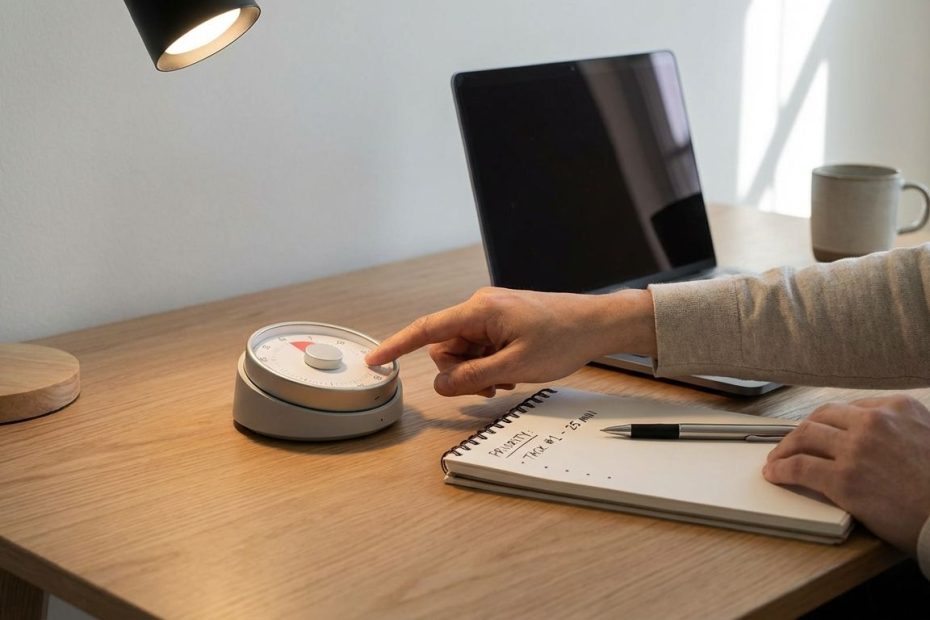
Timed work sprints help because they reduce the mental weight of getting started. A short block feels finite. You are not committing to an endless grind. You are committing to one contained period of focused effort, and that makes difficult work easier to enter.
This is why methods like the Pomodoro Technique stay popular. A defined sprint, often twenty-five minutes followed by a short break, turns vague pressure into a manageable assignment. Your mind stops fixating on the full project and focuses on the clock, the task, and the immediate target. That is useful when procrastination is driven by dread, boredom, or overload.
The main benefit is psychological. You no longer tell yourself to finish everything right now. You tell yourself to work with full attention for one round. That change matters because resistance often comes from the size of the commitment, not the size of the task. A twenty-five minute promise feels safe enough to start. Once you are in motion, continuing usually gets easier.
You can adapt the sprint length to the work. Use shorter blocks when the task feels unpleasant or your attention is unstable. Use longer blocks when you are doing deep thinking, writing, analysis, or problem-solving that needs continuity. The exact duration matters less than the rule behind it: create a bounded period where work has your full attention and distractions stay out.
There is another reason timed work helps. It creates urgency without panic. Open-ended work sessions often drift because there is no clear edge. A timer gives the task shape. You are more likely to act decisively, stay on one thread, and avoid low-value wandering when you know the block has a finish line.
Set a clear objective before each sprint. “Work on project” is too vague. “Draft the opening page,” “solve five problems,” “review three slides,” or “clear the inbox to zero unread from priority clients” gives the block a measurable target. This lets you end the sprint knowing what moved, which strengthens the habit and makes the next round easier to start.
Breaks matter too, but keep them controlled. Stand up, stretch, drink water, or step away briefly. Do not open something that can swallow your attention. A short break should reset your brain, not hijack your next work block. If your break turns into scrolling, the sprint loses much of its value.
Use timed work when starting feels harder than continuing, when a project feels too large, or when your day is scattered and you need structure. It is not a gimmick. It is a simple way to lower the emotional cost of action and protect momentum long enough for real work to happen.
Tip 5: Treat Procrastination As An Emotion Problem, Not Just A Discipline Problem
A lot of bad advice treats procrastination like a moral failure. That framing keeps people stuck because it adds guilt without solving the real issue. In many cases, procrastination is tied to emotional discomfort. The task may trigger boredom, fear of doing it badly, fear of making the wrong choice, resentment, self-doubt, or mental fatigue. If you ignore that layer, you will keep fighting the same delay pattern with raw force.
This is why discipline alone does not solve everything. You can know the deadline matters and still avoid the task if it feels threatening. Your brain is trying to regulate mood in the short term. It reaches for relief now and pushes the cost into the future. That is a poor trade, but it feels good in the moment, which is why the loop repeats.
One common trigger is perfectionism. If you believe the work must be excellent from the start, your standard becomes a source of pressure. You avoid the draft because the draft might disappoint you. You delay the email because the wording may not feel right. You postpone the presentation because once you begin, your ability becomes visible. This is where self-management matters more than self-criticism.
Set a lower entry standard for the first pass. Aim for usable, not polished. Aim for movement, not mastery. Give yourself permission to produce a rough version that you can improve later. That standard protects quality better than waiting for the perfect mental state to appear. Finished rough work can be refined. Untouched work cannot.
Another trigger is overwhelm. When your workload piles up, your brain stops seeing individual tasks and starts seeing one large cloud of pressure. That often leads to freezing, avoidance, and low-value activity that gives the illusion of control. The fix is to lower emotional pressure and restore visibility. Write down what is pending, choose one priority, and define the next action only. You do not need to solve the whole week in one sitting.
Your internal language matters here. Harsh self-talk drains energy and pushes you deeper into avoidance. Replace vague criticism with operational instructions. Not “I am lazy.” Use “The task is unclear, so define the first action.” Not “I always do this.” Use “Reduce the size of the task and start a ten-minute sprint.” Productive self-talk is direct, specific, and tied to behavior.
If procrastination has become chronic and is affecting school, work performance, deadlines, sleep, or mental well-being, do not rely only on hacks. Structured support can help. Coaching, counseling, academic support, or professional evaluation may be useful when delay patterns are persistent and tied to attention issues, anxiety, stress, or other underlying factors. The goal is not to label yourself. The goal is to remove barriers that repeated willpower has not fixed.
Once you stop treating procrastination as proof that something is wrong with your character, you can address it with more precision. That makes your effort more effective. You stop fighting yourself and start managing the actual causes of delay.
How Do You Stop Procrastinating Every Day?
The best daily method is simple: decide your top priority, break it into one visible action, remove distractions, and start with a short timed block. That sequence works because it handles the most common causes of delay all at once. It gives you clarity, lowers resistance, protects attention, and creates enough structure to build momentum.
You do not need a complicated productivity system to make this work. You need a repeatable operating pattern. Pick the task that matters most. Convert it into an action you can begin without thinking too much. Set up your environment so distraction is less available. Then begin before your mind has time to renegotiate the plan. Daily execution improves when you rely less on mood and more on design.
There is also value in reviewing what keeps derailing you. If your mornings disappear into reactive work, guard the first hour for priority tasks. If you delay because tasks feel too big, spend five minutes breaking them down at the end of the previous day. If your phone pulls you away, remove it before every work block. Small corrections repeated daily produce more output than occasional bursts of motivation.
You should also watch for false productivity. Busy does not always mean effective. Answering messages, organizing files, color-coding notes, and reading more advice can feel useful without moving the work that matters. Strong performance comes from doing the important task early and often, even when it is less pleasant than the alternatives sitting in front of you.
Consistency matters more than intensity. One solid hour of focused work each day on a priority task will outperform a cycle of avoidance followed by panic. The goal is not to wait for the perfect state. The goal is to make progress the standard behavior, even on ordinary days.
How Do You Beat Procrastination and Get More Done?
- Start with one tiny, clear action
- Break big tasks into simple steps
- Remove distractions before working
- Use short timed work sprints
- Focus on progress, not perfection
Start Smaller, Move Faster, Finish More
Procrastination loses power when you stop treating work as one giant demand and start managing the small decisions that shape action. Make the starting point tiny, turn big projects into visible steps, remove distractions before they can pull you off course, and use timed sprints to create momentum without drama. Keep your standards high for the final result, but keep the entry point easy enough to begin right away. If delay keeps returning, address the emotion behind it instead of adding more guilt. The more often you start on purpose, the more often you finish with control.
References
- https://pmc.ncbi.nlm.nih.gov/articles/PMC12514333/
- https://pmc.ncbi.nlm.nih.gov/articles/PMC11199680/
- https://pmc.ncbi.nlm.nih.gov/articles/PMC7400384/
- https://pmc.ncbi.nlm.nih.gov/articles/PMC12512977/
- https://calnewport.com/monday-master-class-pulverize-large-assignments-with-the-ess-method/
- https://calnewport.com/deep-habits-jumpstart-your-concentration-with-a-depth-ritual/
- https://extension.harvard.edu/blog/6-strategies-for-maintaining-momentum-chaotic-times/
- https://www.reddit.com/r/productivity/comments/1o33s8n/how_do_i_stop_the_procrastination/
- https://www.reddit.com/r/Procrastinationism/comments/1g5c7p7/how_to_stop_procrastinating_for_real_no_bs/
- https://www.reddit.com/r/getdisciplined/comments/1ix3rn0
- https://www.reddit.com/r/selfimprovement/comments/di69yk
- https://www.reddit.com/r/howto/comments/1rfod9c/how_to_stop_procrastinating_and_actually_do_the/
- https://www.reddit.com/r/selfimprovement/comments/1o71gfi/how_can_i_stop_procrastinating/

Mark R Graham is a private equity executive and co-founder of Drake, Goodwin & Graham, with over 20 years of experience in alternative assets and M&A. A former Vice President at Morgan Stanley and practicing attorney, he now focuses on strategic investments and educational philanthropy.